Weekly Thesis
The Signal Ledger weekly wrap, Friday, October 9, 2026.
State Street SPDR S&P 500 ETF Trust (SPY) closed the week at $778.57, up +0.60% on Friday and +1.16% over five sessions, finishing the week roughly where it started after a choppy round trip. The index touched both a fresh high and a mid-week stumble: Tuesday's close near $779.09 gave way to back-to-back losses Wednesday and Thursday before Friday's rebound. Along the way, crude oil whipsawed from above $92 early in the week to below $89 mid-week and back to $91.61 by Friday, natural gas ran hard most sessions, and the 10-year Treasury yield pushed to 5.24% with the 2s10s spread near +44 bps — a combination that again paired higher long-end yields with resilient, if uneven, equities.
Participation told a more interesting story than the index-level churn. The five-session read shows 8 of 11 sectors beating SPY with Invesco S&P 500 Equal Weight ETF (RSP) outperforming SPY by +0.42%, a genuine break from the 21-session streak of narrow participation flagged in prior weeks. But the 20-session window still shows only 2 of 11 sectors beating SPY and RSP trailing by -2.60%, so this looks like a short-lived breadth pulse inside a still-narrow longer trend rather than a confirmed regime change. Factor data reinforces the ambiguity: momentum (MTUM) lagged SPY by -2.05% over five sessions while low-volatility (USMV) and quality (QUAL) outperformed — a defensive rotation inside an up week, not a momentum chase.
The week's dominant cross-currents were energy and rates. WTI Crude Oil Futures (CL=F) swung roughly $92 to $89 and back to $91.61, while natural gas futures (NG=F) gained in four of five sessions. Despite the volatility, State Street Energy Select Sector SPDR ETF (XLE) only loosely tracked the oil moves and still shows no sustained multi-day sector leadership on a 20-session view, which keeps the “geopolitical premium, not regime shift” framing intact. Meanwhile Treasury yields extended higher yet again — the 10-year at 5.24%, the 2-year at 4.80% — with SPY still holding above its 20-, 50-, and 200-day averages at Friday's close. That combination continues to argue for growth tolerance rather than imminent cuts, though the move was modest enough this week (2-year +5 bps, 10-year +2 bps on Friday alone) that it adds confirmation without changing magnitude.
Crypto added a volatility note worth a brief mention: Bitcoin (BTC) slid from roughly $85,800 on Monday to a weekly low near $81,750 Thursday before stabilizing around $82,446 Friday, a roughly -4% round trip that tracked the broader risk-asset wobble mid-week. Polkadot (DOT) was a standout mover late week (+12.38% on Friday), but without corroborating fundamental news this reads as idiosyncratic rather than thematic.
SPY Decision Map
Close: $778.57 Posture: Above the 20-day average at $767.98; above the 50-day average at $767.57; above the 200-day average at $722.93. Latest volume was 0.50x its 20-session median.
- Decision: $775.75-$780.50 (moderate confluence) - the August 13 swing high, the August 5 swing high, Friday's close, and Friday's high converge in this band. It separates a recovery back through recent structure from continued rejection beneath it.
- Support: $771.50-$775.75 (strong confluence) - last month's high, last week's high, the September 22 swing high, and the September 3 swing high define the nearest cluster of downside reference points. Holding the band preserves the recent range; losing it removes the nearest structural floor.
- Resistance: $780.50-$782.75 (strong confluence) - 252-session high, 63-session high, 20-session high, and the October 6 swing high form the nearest qualified overhead cluster. Clearing the band would move SPY through the recent range ceiling; rejection keeps that ceiling active.
Reference zones, not price targets or trade recommendations.
ETF / Sector Leadership
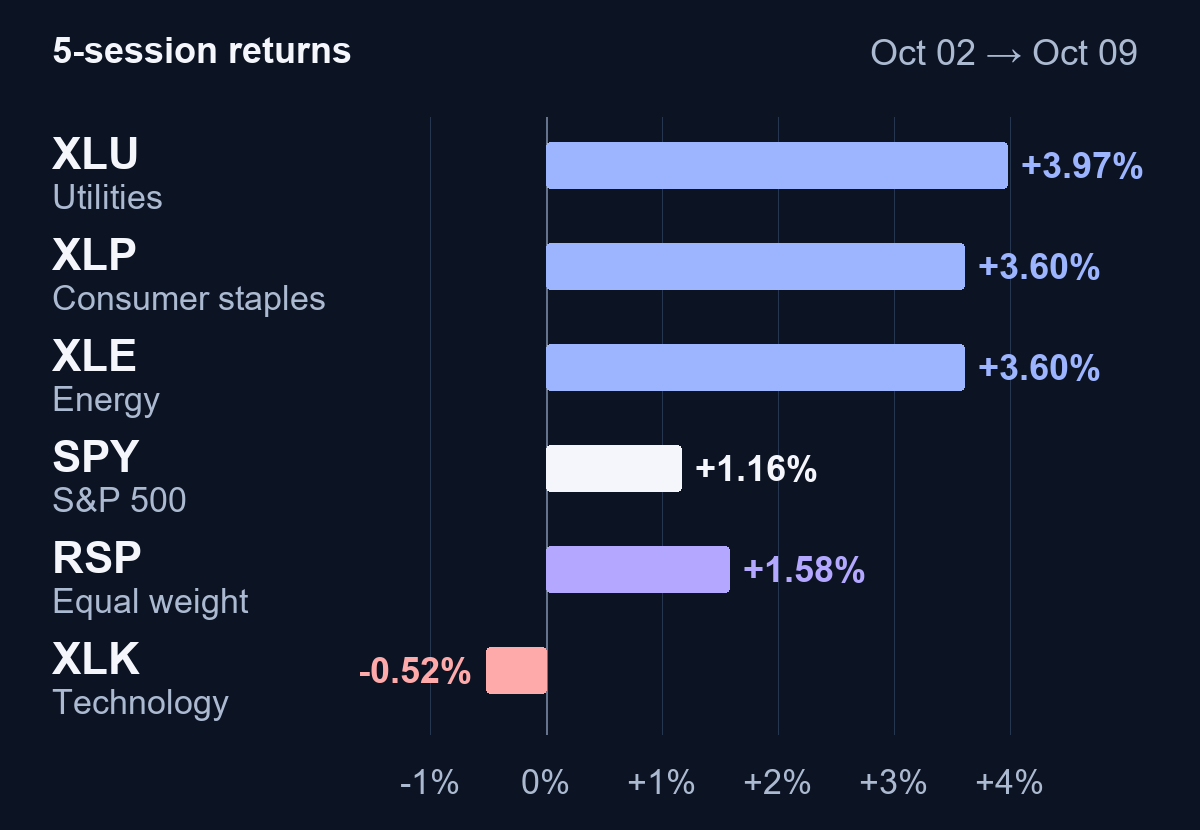
Participation this week was mixed rather than clearly broad or narrow. The five-session sector scoreboard shows 8 of 11 sectors outpacing SPY, with State Street Utilities Select Sector SPDR ETF (XLU) (+3.97%), State Street Consumer Staples Select Sector SPDR ETF (XLP) (+3.60%), and State Street Energy Select Sector SPDR ETF (XLE) (+3.60%) leading and State Street Technology Select Sector SPDR ETF (XLK) the lone laggard at -0.52%. That is a genuine improvement from the narrow-breadth pattern that persisted for three weeks running, and the equal-weight proxy Invesco S&P 500 Equal Weight ETF (RSP) beat SPY by +0.42% over the same window — the first such outperformance after 21 consecutive narrow readings.
Zoom out to 20 sessions, though, and the picture reverts to concentration: only 2 of 11 sectors beat SPY, State Street Technology Select Sector SPDR ETF (XLK) still leads at +6.04%, and Invesco S&P 500 Equal Weight ETF (RSP) trails SPY by -2.60%. In other words, this week's breadth pulse sits inside a still-narrow longer trend. Leadership also rotated hands within the week — State Street Consumer Staples Select Sector SPDR ETF (XLP) entered the leader group while State Street Technology Select Sector SPDR ETF (XLK) exited it, a classic late-week defensive tilt rather than a durable handoff.
Factor evidence supports a defensive characterization of the week's internals: iShares MSCI USA Min Vol Factor ETF (USMV) (+2.36%) and iShares MSCI USA Quality Factor ETF (QUAL) (+1.18%) outperformed SPY over five sessions, while iShares MSCI USA Momentum Factor ETF (MTUM) (-0.89%) and Invesco S&P 500 Momentum ETF (SPMO) (-1.35%) lagged by roughly two points. That is consistent with a market absorbing rate and energy volatility by favoring steadier names rather than chasing momentum leaders. Energy's week-over-week surge in daily returns (XLE +3.60% over five sessions) tracked the oil and natural-gas rally late in the week but has not yet produced sustained 20-session sector leadership, keeping the “risk premium, not regime shift” framing intact for energy.
Stocks
Health care and pharma names had an outsized week. Moderna (MRNA) was the most volatile name on the board: it jumped +6.95% Monday, cratered -7.75% Tuesday, then rebuilt ground through the week to close +14.21% Friday alone — a round trip that ended well above where it started, though the swings suggest continued headline sensitivity rather than a settled narrative. American Tower (AMT) jumped +9.30% Friday, a sharp one-day move that stands out against its typically steady real-estate profile and should be read cautiously pending further confirmation.
Cybersecurity and software strength carried into Friday: Palo Alto Networks (PANW) gained +5.09%, CrowdStrike (CRWD) +4.57%, and Palantir (PLTR) +5.17%, extending a pattern of AI- and security-adjacent demand even as the broader tech complex (XLK) lagged the sector tape over five sessions. Oracle (ORCL) whipsawed hard — down -5.48% Thursday, then +4.21% Friday — reflecting elevated name-specific volatility rather than a clean trend.
On the downside, T-Mobile US (TMUS) fell -13.27% and Verizon (VZ) dropped -10.14% Friday, both sizable one-day losses in telecom that materially weighed on the Communication Services sector (XLC -1.51% Friday, the day's weakest sector). Deere (DE) slid -4.85%, Chipotle (CMG) -3.34%, and Starbucks (SBUX) -2.64%, continuing a softer stretch for select consumer and industrial names. PepsiCo (PEP) reported quarterly results this week with EPS of 2.34 versus a 2.32 estimate and revenue of $25.3B versus $25.2B consensus — both modestly above expectations — yet the stock still fell roughly -1.85% on Friday, suggesting the market was more focused on forward commentary than the in-line beat; confirmation of that read would come from sustained post-earnings weakness rather than a single session's move.
Upcoming Catalysts
The coming two weeks bring a dense earnings and data calendar. Bank earnings dominate next week: Citigroup (C), Goldman Sachs (GS), JPMorgan Chase (JPM), Wells Fargo (WFC), and Johnson & Johnson (JNJ) report October 13, followed by Bank of America (BAC), BlackRock (BLK), and Morgan Stanley (MS) on October 14. UnitedHealth Group (UNH) also reports October 13. These results will offer the first broad read on credit quality and loan demand against the backdrop of rising long-end yields.
On the macro calendar, the Consumer Price Index is due October 14, followed by the Producer Price Index on October 15 and Import/Export Price Indexes on October 16 — a cluster of inflation data that could directly test the thesis that rising yields reflect growth tolerance rather than inflation concern. Given the 10-year yield's push to 5.24% this week, these releases carry elevated importance for rate-sensitive sectors including real estate and utilities, this week's leaders.
Later in the month, mega-cap and industrial earnings pick up: GE Aerospace (GE) on October 19, Tesla (TSLA), Netflix (NFLX), Intuitive Surgical (ISRG), and RTX (RTX) around October 20-21, and IBM (IBM), Texas Instruments (TXN), Thermo Fisher Scientific (TMO), and Danaher (DHR) on October 21. Exxon Mobil (XOM) and SLB (SLB) report October 23, which should sharpen the read on whether energy's recent price volatility is translating into earnings durability.
Thesis Ledger
| Thesis | First stated | Evidence this week | Status | What changes the view |
|---|---|---|---|---|
| Broad participation supports the equity uptrend beyond mega-cap tech | 2026-08-14 | Five-session breadth improved sharply (8 of 11 sectors beat SPY, RSP +0.42% vs SPY), but the 20-session view still shows only 2 of 11 sectors beating SPY and RSP trailing by -2.60% | Unchanged | Multiple consecutive weeks of RSP outperformance and improved 20-session breadth, not just a single week's pulse |
| Energy-led rally reflects a geopolitical risk premium, not a durable regime shift | 2026-08-14 | WTI Crude Oil Futures (CL=F) swung from above $92 to below $89 and back to $91.61; XLE posted a strong +3.60% five-session gain but still lacks sustained 20-session sector leadership | Unchanged | XLE sustaining multi-day sector leadership across both 5- and 20-session windows alongside a stable, non-reversing oil trend |
| Rising yields alongside equity resilience signal growth tolerance rather than imminent rate cuts | 2026-08-14 | The 10-year yield reached 5.24% and the 2s10s spread held near +44 bps; SPY still closed the week above its 20-, 50-, and 200-day averages despite mid-week equity weakness | Strengthened | A sharp equity drawdown coinciding with falling yields, which would instead suggest a growth-scare regime |
Disclaimer
The Signal Ledger is a free beta build of an unreleased product. Features and delivery may change during testing.
AI and automated production disclosure: The Signal Ledger uses automated data pipelines to gather and calculate market information and generative AI to synthesize source material and draft narrative content. Reports may be distributed automatically without individual human review before publication. Although delivered reports are monitored afterward, automated and AI-generated content may contain errors, omissions, stale information, or misinterpretations. Readers should independently verify material facts, prices, dates, calculations, and source information before relying on them.
Educational only; not financial advice. The Signal Ledger provides general educational and informational content, not personalized financial, investment, tax, legal, or accounting advice. Nothing in this report is a recommendation to buy, sell, hold, or trade any security, asset, or strategy. You are responsible for your own decisions and risk management.
Beta product feedback is welcome. Please reply directly to this newsletter email with your thoughts. If you have Discord access, you may also leave feedback in the #beta-feedback channel. Discord access should not be assumed.
Related Tickers
State Street SPDR S&P 500 ETF Trust (SPY), Invesco S&P 500 Equal Weight ETF (RSP), iShares MSCI USA Momentum Factor ETF (MTUM), iShares MSCI USA Min Vol Factor ETF (USMV), iShares MSCI USA Quality Factor ETF (QUAL), State Street Energy Select Sector SPDR ETF (XLE), Bitcoin (BTC), Polkadot (DOT), State Street Utilities Select Sector SPDR ETF (XLU), State Street Consumer Staples Select Sector SPDR ETF (XLP), State Street Technology Select Sector SPDR ETF (XLK), Invesco S&P 500 Momentum ETF (SPMO), Moderna (MRNA), American Tower (AMT), Palo Alto Networks (PANW), CrowdStrike (CRWD), Palantir (PLTR), Oracle (ORCL), T-Mobile US (TMUS), Verizon (VZ), State Street Communication Services Select Sector SPDR ETF (XLC), Deere (DE), Chipotle (CMG), Starbucks (SBUX), PepsiCo (PEP), Citigroup (C), Goldman Sachs (GS), JPMorgan Chase (JPM), Wells Fargo (WFC), Johnson & Johnson (JNJ), Bank of America (BAC), BlackRock (BLK), Morgan Stanley (MS), UnitedHealth Group (UNH), GE Aerospace (GE), Tesla (TSLA), Netflix (NFLX), Intuitive Surgical (ISRG), RTX (RTX), IBM (IBM), Texas Instruments (TXN), Thermo Fisher Scientific (TMO), Danaher (DHR), Exxon Mobil (XOM), SLB (SLB)